Saskatchewan Income Support (SIS)
SIS is Saskatchewan's main income help for people in financial need. It pays a monthly Basic Benefit plus a Shelter Benefit that covers rent, mortgage, utilities, and taxes, with extra benefits on top. For example, in Saskatoon or Regina the Shelter Benefit is $675 for singles and $865 for couples without kids (as of May 1, 2026).
What you get
Up to $375/month
Who it's for
You qualify if you are a Canadian citizen, permanent resident, refugee, or person under the Canada-Ukraine emergency travel program; live in Saskatchewan; are 18 or older; have no or low income; and have looked at every other reasonable source of support, like work or child support.
This takes you to the official website
Depends on your household size and income.
What to have ready
Documents they may ask for
- Government ID for everyone in your household, if available
- A copy of your lease or rent agreement
- Recent rent receipt, ledger, or proof of what you owe
- Recent pay stubs, benefit statement, or income proof
- ODSP, Ontario Works, CPP, OAS, or other benefit statement if you have one
- Recent bank statement, if the program asks for it
What to say when you call
“Hi, I found your housing support program and I want to check if I can apply. Can you tell me the current rules, documents needed, and the next step?”
Use the official page first, then call 211 if you are not sure where to start.
Can I get this?
You have a good chance if this sounds like you:
- If you have a spouse or partner, you apply together
What to do next
Check off each step as you go — we'll remember where you are.
Checkmarks are saved only on this device. We collect nothing.
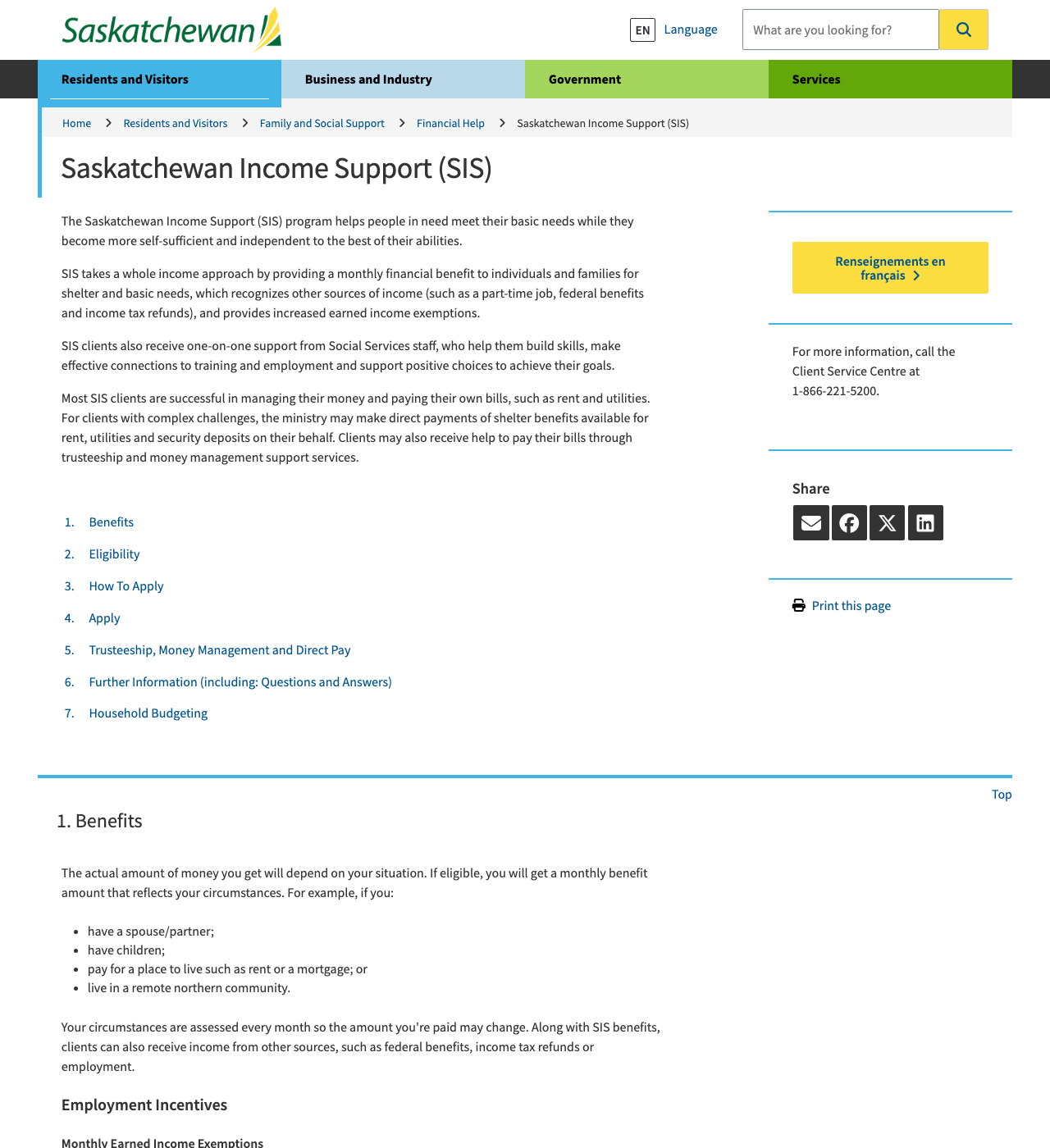
What the official page looks like
The fine print
More details about the money
Rates effective May 1, 2026. Adult Basic Benefit: $375/month ($445 within the Northern Administration District); Children's Basic Benefit $65/child. Shelter Benefit (Saskatoon/Regina): singles $675, couples without dependent children $865, families 1-2 children $1,105, families 3+ children $1,287. Shelter Benefit (remainder of province): singles $615, couples $750, families 1-2 children $860, families 3+ children $965. Supplements include a Shelter Stabilization Benefit ($150/month), Alternate Heating Benefit ($190/month), Household Health and Safety Benefit (up to $500), Relocation Benefit ($200 or $300), Prescribed Diet Benefit ($50-$150), Employment and Training Benefit ($140), Children's Benefit ($400), Child Care Benefit ($30/day), plus Security Deposit (up to the Shelter Benefit amount) and Funeral Benefits. Monthly earned-income exemptions: single $375, couple without children $475, family $500.
Amounts and eligibility change. Confirm the current figure with the program administrator through the official link before you rely on it.
The full eligibility rules
Canadian citizen, permanent resident, refugee, or person in Canada under the Canada-Ukraine authorization for emergency travel; living in Saskatchewan; 18 or older; no income or low income; and have explored every other reasonable means of support (employment, child support, etc.). Spouse/partner must apply together.
Good to know
All rates read directly from saskatchewan.ca and are stated as effective May 1, 2026 - amounts change periodically, reconfirm before relying on them. Shelter Benefit rates differ between Saskatoon/Regina and the rest of the province; Basic Benefit differs inside vs outside the Northern Administration District.
People also look at
Up to $1,336/month
Depends on your household size and income
Basic Income Program (Programme de revenu de base)
This is a more generous last-resort benefit for people who have had a long-term, severe limit on their ability to work.
Up to $1,574
Depends on your household size and income
Social Assistance Program (Aide sociale) - including shelter needs
This is Quebec's last-resort help for adults with little or no income who do not have a severe limit on their ability to work.
Up to $250/month
Yukon Supplementary Allowance
This adds $250 a month on top of social assistance if you cannot work because of a severe or long-term disability, or if you get (or are old enough to get) Old Age Security.